BIRTHDAY TO' WAN  

Posted by Chon On Blog


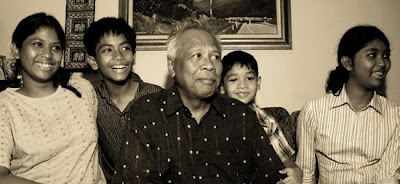
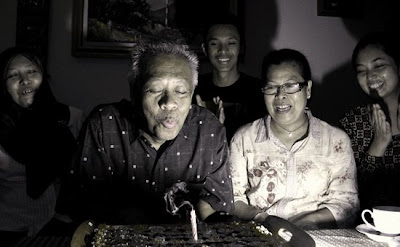
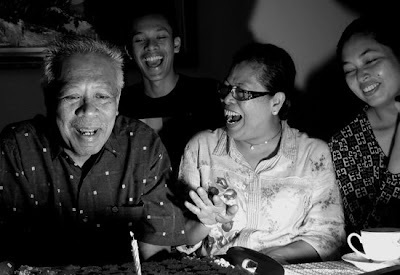
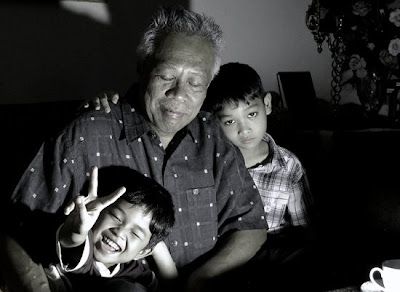
My father-in-law celebrated his 71st birthday over the weekend. The kids decided to spring a surprise on their grandfather by presenting him with an unconventional birthday cake in the form of cute colourful cupcakes, which they baked themselves with Mama in-charge, of course. What made it more special was the fact that this was the first time they had the opportunity to celebrate their grandfather’s birthday with him. He happened to be in town that weekend.

For someone who is almost three-quarters of a century old, my father-in-law is still full of zest and refuses to live the life of a retiree. Come to think of it, he is in fact still actively working, blogging and traveling!

It is my wish that my children could spend more time with him, and unabashedly let their grandfather know that they love him so dearly and how they look up to their to'wan. After all, he is the only grandfather they ever know.


MERDEKA YANG SURAM  

Posted by Chon On Blog


Selalunya ketika ini, Jalur Gemilang sudah lama saya kibarkan di rumah kami.

Anak-anak akan bertanya itu dan ini tentang kemerdekaan dan sejarah tanahair kita. Saya pula tidak berasa jemu menceritakan peristiwa-peristiwa bersejarah kepada mereka.

Saya juga tidak akan lupa menceritakan kisah saya pernah berjumpa dengan Bapa Kemerdekaan kita, Almarhum Tunku Abdul Rahman Putra Alhaj. Betapa dia melayan saya dengan mesra, laksana seorang datuk melayan cucunya ketika saya menemu ramah beliau beberapa kali dahulu.

Saya juga tidak jemu-jemu mencari bahan-bahan bacaan mengenai jejak-jejak kemerdekaan Malaysia supaya anak-anak tidak lupa. Berkongsi pengetahuan dengan mereka tentang sejarah Malaya, penubuhan Malaysia, termasuklah bagaimana Sabah dan Sarawak menyertai Malaysia.

Kalau nenek mereka ada di rumah di bulan kemerdekaan, mereka akan mendengar cerita mengenai era penjajahan Jepun, keganasan komunis dan bagaimana datuk nenek mereka bangkit menuntut kemerdekaan daripada British.

Tetapi entah kenapa semangat kami tahun ini kendur. Suasana menyambut kemerdekaan amat suram. Begitu sedikit bendera negara yang saya lihat berkibaran, baik di rumah, bangunan mahupun kenderaan. Begitu suram kali ini.

Malah, saya belum mengibarkan Jalur Gemilang di rumah kami tahun ini padahal 31 Ogos tinggal 7 hari lagi.

Saya tahu apa puncanya tetapi malas hendak diceritakan. Saya percaya anda juga begitu. Jika tidak, masakan anda pun tidak mengibarkan Jalur Gemilang!

Jangan salah saham, saya amat menyayangi negara saya. Inilah tempat tumpah darah saya. Di sini saya dilahirkan, membesar, berkeluarga dan di sini juga saya ingin disemadikan. Jika perlu, saya pasti di barisan hadapan untuk mempertahankan Ibu Pertiwi ini.

Sudah puluhan kali saya ke luar negara, ke negara miskin dan negara maju. Setelah beberapa hari di sana, saya pasti rindukan negara saya, Malaysia dan sentiasa teruja setiap kali pesawat memasuki ruang udara negara. Kelakar, macam lah saya sudah meninggalkan negara berpuluh tahun tetapi itu hakikatnya. Amat gembira dapat pulang ke negara sendiri.

Tetapi, tahun ini, ada yang tidak kena. Suram dan muram. Sedih pun ada, kecewa terasa juga. Bagaimana dengan anda?


THE MAGNIFICENT ELEVEN  

Posted by Chon On Blog


A rare photograph of the Magnificent Eleven. It was taken by our eldest brother-in-law (he was the only one with a camera then) in front of our house in Lorong Liku, Bakar Bata in Alor Setar.

This picture is ‘rare’ because in those days it was not often that we had a chance to get our photographs taken, and to get one of all eleven of us together was nearly impossible then.

It was taken in December 1970, when I was 9 years old. Back row, standing from left, Sibling Number 2 Halim, Number 5 Johari (deceased), Number 6 Mahadzir, Number 3 Sobrey. Second row, from left, Number 7 Rashida, Number 1 Zakiah, Number 4 Fuziyah, and Number 8 Ahmad Kamal. Front row, from left Chon-on-Blog aka Hardknocks, Number 11 Haslinda and Number 10 Salahuddin.

All grew up to be successful in their own rights. Between all eleven of us, we have 49 children, some of whom are now married and with children of their own. It would be interesting if we can all gather together for a complete family photograph! How I wish all of us could ‘balik kampung’ this Aidilfitri for another rare photo session. We will probably need a superwide angle lense to capture everyone in one picture.


VITILIGO (Pronounced /Vertil~eye~go)  

Posted by Chon On Blog


I know of a school friend suffering from this skin disorder. Oh my, how he suffered… He didn’t have many friends in school then and I’m sure, doesn’t have many, still.

With those white patches on his hands and cheeks, my friend was, how should I say, not normal. Most students shunned him. He was a social outcast, of sort. I cannot recall seeing him at any of our gatherings…you know… parties, campings etc.

He was a bright student but was reclusive because of the condition, sopak as we know it in Malay. He didn't mix around much, avoided crowd. Surely he was ashamed of his condition. Depressed, his results were in the red zone, his studies were effected, future doomed. We were of not much help either. We didn’t know what to do to lift his spirit because we knew next to nothing about the condition. He didn’t do well in school and after Form 5, returned to his kampung in Baling to help his father tap rubber.

We wrote to each other a few years after school. Then his letters stopped coming. I lost touch with him thereafter, until I was posted to Alor Setar. I was on an assignment in Baling Town one day in late 1990s, covering the visit of former prime minister Datuk Seri (now Tun) Dr Mahathir Mohamad to the district, when I noticed a familiar face in the crowd. It was him, my long lost friend, standing a distance away from the rest. I approached him, reminded him of who I was, and saw his face lit up.

After completing my work, we went for a drink and shared our life stories. It saddened me to find out that my friend was still very much a loner. He still had the condition, which by then, had spread to most of his face and body. Poor him.

What is this condition called vitiligo? According to Wikipedia, vitiligo or leukoderma is a chronic skin disease that causes loss of pigment, resulting in irregular pale patches of skin. The precise cause of vitiligo is complex and not fully understood. There is some evidence suggesting it is caused by a combination of auto-immune, genetic, and environmental factors. The population incidence worldwide is considered to be between 1% and 2%.

Half of people with vitiligo develop patches of de-pigmented skin appearing on extremities before their 20s. The patches may grow, shrink, or remain constant in size. Patches often occur symmetrically across both sides on the body. Occasionally small areas may repigment as they are recolonised by melanocytes.

The location of vitiligo affected skin changes over time, with some patches re-pigmenting and others becoming affected.

Vitiligo may also be caused by stress that affects the immune system, leading the body to react and start eliminating skin pigment.

Vitiligo on the scalp may affect the color of the hair (though not always), leaving white patches or streaks. It will similarly affect facial and body hair.

Some symptoms are:
  • white patches on the skin, including the face, limbs, torso, and groin

  • purple or golden brown patches on mucous membranes and around the eyes, nostrils, and mouth;

  • premature graying of hair;

  • sun sensitivity

Vitiligo is associated with autoimmune and inflammatory diseases, commonly thyroid overexpression and underexpression.

Vitiligo can have a significant effect on the psychological well being of the patient. This is especially true for darker skinned patients as the contrast between pigmented and depigmented skin can be quite drastic.

In some cultures there is a stigma attached to having vitiligo. Those affected with the condition are sometimes thought to be evil or diseased and are sometimes shunned by others in the community. People with vitiligo may feel depressed because of this stigma

There are a few famous people inflicted with this skin disorder, among them:

  • Amitabh Bachchan, Leading Bollywood Celebrity, diagnosed with the condition in the 1980s. In fact the patches on the hand are quite visible in a number of movies, such as Agneepath.

  • Michael Jackson, revealed he suffers during an interview on the The Oprah Winfrey Show in 1993, after being diagnosed in the early 1980s.

Why does this concern me? As a matter of fact, it does concern me, my family alot….specifically my son, Adil or Patpat, as we affectionately call him.

My wife and I thought a white spot on his right cheek, under his eye was just a fungus infection...panau, in Malay. Took him to the doctor, who gave creams to apply but the white spot didn’t vanish. Instead, it grew bigger to about the size of a 20 sen coin! Another spot also appeared at the corner of his right eye, at the end of the eyebrow.

A couple of months later, we decided to take him to a dermatologist. It was then we found out that stubborn white spot was actually vitiligo. Instantly, I remembered my friend in Baling and of his “sufferings”. It shudders me to think of the emotional effect this condition would have on my son. Like how it ruined my friend's life!

Patpat is on medication now and the spot, I observed, is fading. It is not as pale as before. We are praying for the best and InsyaAllah, won’t give up finding the cure for him, no matter how much it will cost us as long as we can spare him from the embarrassment.

We earnestly hope Patpat will lead a normal life, grow up happy, smart, well liked by all and achieve his ambition of becoming a neurosurgeon, that is if he fails to become a cardiologist. That was what he told me. ("I want to save lives. Make lots of money and drive a Ferrari. I'll buy you a BMW convertible, Pa," said Patpat of his dream job. Kids nowadays! When I was small, I only wanted to drive a bus...). Neurosurgeon, cardiologist, scientist, pilot, lawyer, teacher, soldier, entrepreneur...whatever, I just want him to be healthy and happy.

That reminds me..I must do something about that Playstation game!!!


ABOUT MOON...  

Posted by Chon On Blog


Three days from today, the world celebrates the 39th anniversary of man’s first landing on the Moon. I was among the millions who were glued to their TV screens, watching history being made. 8 years old, I was awestruck. I heard Neil Armstrong uttering those famous words “One small step for man, one giant leap for mankind”. Of course, at the time, I could only understand the words “man” and “giant”.


I suppose this was also the time the expression “The eagle has landed” was coined. The Eagle was the lunar vehicle that took Neil Armstrong and Buzz Aldrin to the surface of the Moon. It descended in the Sea of Tranquility on the Moon’s surface. That first moon-landing was what eventually inspired mankind to achieve the impossible, to reach for the star, so to speak.


I guess man has since the beginning of time been fascinated by the Moon. How else would you explain the many expressions in the languages that allude to the Moon, like ...


To ask/cry for the moon - to want something that is not possible.
To be over the moon - to be extremely pleased about something
Many moons ago - a long time ago.
To promise (someone) the moon - to promise something impossible
To reach for the moon/stars - to try to achieve something that is very difficult.
To think someone hung the moon - you really look up to or admire someone.
To visit the man in the moon - to do something that is unlikely.
And the familiar Once in a blue moon, which means very rarely.

Once in a Blue Moon
A truly rare occurrence is to witness a full moon twice in one month – however, it does happen. The Farmer’s Almanac dates back as far as 1792. A few years later in 1820, Maine became a state. (Not to say that farmers did not keep almanacs before statehood was recognized). Maine farmers would record the full moon in red print for each month. When a second full moon occurred in the same month, the ink was changed to blue. Blue moons have never occurred in the month of February.

In Malay, we have the following expressions that relates to the moon, or bulan …


Bagai bulan kesiangan

Bulan jatuh ke riba

Bagai bulan dipagar bintang

Bagai pungguk rindukan bulan

Seperti si-cabul hendak mencapai bulan

Or …

Bulan madu

….. even …. Datang bulan

For wage earners like me ...

Awal bulan - a happy moment

Tengah bulan - dry spell

Hujung bulan - happy once more


There are also nursery rhymes about moon. Bet you were taught this in school…


Hey diddle diddle,
the cat and the fiddle,
The cow jumped over the moon,
The little dog laughed to see such sport,
And the dish ran away with the spoon.


By the way, do you know that there is a town in Perry County, Kentucky of the United States called Bulan? There was also a ruler, King Bulan, the first Jewish king of the Khazar Kingdom. He was converted to Judaism by Rabbi Yitzhak HaSangari during the 9th century. Khazars were a Turkic people of early southern Russia. A portion of the Khazar people was Jewish and intermarried with Jews. The Khazars lost their independent kingdom in 1016.


But, how much do we know about the Moon? I googled the following facts:


The Moon is the only natural satellite of Earth. Its diameter measures 3,476 km and it rotates along an orbit 384,400 km from Earth.


Called Luna by the Romans, Selene and Artemis by the Greeks, and many other names in other mythologies.


The Moon, of course, has been known since prehistoric times. It is the second brightest object in the sky after the Sun. As the Moon orbits around the Earth once per month, the angle between the Earth, the Moon and the Sun changes; we see this as the cycle of the Moon's phases. The time between successive new moons is 29.5 days (709 hours), slightly different from the Moon's orbital period (measured against the stars) since the Earth moves a significant distance in its orbit around the Sun in that time.


The Moon was first visited by the Soviet spacecraft Luna 2 in 1959. It is the only extraterrestrial body to have been visited by humans. The first landing was on July 20, 1969; the last was in December 1972. The Moon is also the only body from which samples have been returned to Earth.


The gravitational forces between the Earth and the Moon cause some interesting effects. The most obvious is the tides. The Moon's gravitational attraction is stronger on the side of the Earth nearest to the Moon and weaker on the opposite side.

Since the Earth, and particularly the oceans, is not perfectly rigid it is stretched out along the line toward the Moon. From our perspective on the Earth's surface we see two small bulges, one in the direction of the Moon and one directly opposite.

The effect is much stronger in the ocean water than in the solid crust so the water bulges are higher. And because the Earth rotates much faster than the Moon moves in its orbit, the bulges move around the Earth about once a day giving two high tides per day.

The Moon isn't just in the sky. It's just about everywhere we look, although we may not realize it. That buttery croissant you might have eaten for breakfast was originally a Gallic communion cake inspired by the crescent Moon; princesses and the girl next door have been named after the goddess identified with a phase of the Moon. We've all heard about how the Moon is made of green cheese, or that strange little men live upon it; but how many of us knew that the maiden name of Buzz Aldrin's maternal grandmother was "Moon," or remembered that men brought back 47.7 pounds of the Moon on that first mission 39 years ago?


HoustonChronicle.com takes a look at some of these fascinating facts, and equally fascinating lunar legends.


Fact: Earth is the planet nearest the Sun to be orbited by a moon.
Legend: Among ancient cultures that worshipped heavenly bodies, the moon was always the most important. Many primitives revered the moon more than the sun, reasoning that the Moon-mother gives her light at night, when it is needed, while the sun shines only by day.


Fact: With a diameter of 2,160 miles, the Earth's moon is one of the largest in our solar system.
Legend: Within the cosmic order, the Moon is regarded as a duplication of the sun but in diminished form because, if the Sun brings life to the entire planetary system, the Moon influences only Earth.


Fact: A woman has never set foot on the Moon.
Legend: The Moon is the Great Eternal Mother. In central Asia, it was said that the Moon is the Goddess' mirror reflecting everything in the world. Sioux Indians called the Moon "The Old Woman Who Never Dies." In many cultures, the Moon-goddess and the Creatress were one and the same. The Moon ruled the sexuality of women and sometimes made them scornful of male-dominated society. St. Augustine berated women for dancing "impudently and filthily all the day long upon the days of the new moon."


Fact: Twelve men have explored the lunar terrain. They are: Neil Armstrong and Edwin "Buzz" Aldrin, Apollo 11; Alan L. Bean and Charles "Pete" Conrad Jr., Apollo 12; Edgar D. Mitchell and Alan B. Shepard, Apollo 14; James B. Irwin and David R. Scott, Apollo 15; Charles M. Duke Jr. and John W. Young, Apollo 16; and Eugene A. Cernan and Dr. Harrison H. Schmitt, Apollo 17.
Legend: Some say the man in the Moon is a man leaning on a fork, on which he is carrying a bundle of sticks picked up on a Sunday. Another tradition says that the man is Cain, with his dog and thorn bush. The thorn bush is said to represent the thorns and briars of the fall, and the dog is the "foul fiend." Some poets claim the man in the moon is Endymion, taken there by Diana.


Fact: At new moon and at full moon, the tides raised by the moon are reinforced by the Sun; these are the "spring tides."
Legend: As the Moon governs the sea's tides, so it governs the tides of life and death. Shore-dwellers believed that a baby can be born only on an incoming tide and a dying person cannot expire until the tide goes out. Birth at a full tide or a full moon means a lucky life. Scottish girls refused to schedule a wedding day for any time other than the full moon, the most fortunate time for women.


Fact: The closest the Moon can come to Earth -- its perigee -- is 221, 463 miles. The farthest it can go away -- its apogee -- is 252,710 miles.
Legend: The progressive change in the shape of the Moon gives birth to a mystic theory of forms that influences the construction of musical instruments and the characters of the Hebrew and Arabic alphabets.


Fact: If the plane of Earth's orbit around the sun and the plane of the Moon's orbit around Earth were the same, the Moon would be eclipsed by Earth every time it is full, and the Sun would be eclipsed by the Moon every time the moon is "new." But because the two orbits do not coincide, the Moon's shadow normally misses Earth, and Earth's shadow misses the moon.
Legend: Animals regarded as lunar are those which alternate between appearance and disappearance, like the amphibians. Examples are the snail, which leaves its shell and returns to it, or the bear, which vanishes in winter and reappears in spring.


Fact: It takes 27.3 days for the Moon to make its circuit around Earth.
Legend: Ancients based their calendars on the phases of the moon and menstrual cycles because they believed the Moon-goddess created time, with all its cycles of creation, decline, and destruction. The moon still determines agricultural work in parts of India.


Fact: During the first lunar landing, man spent 21 hours and 36 minutes on the Moon's surface.
Legend: Kastor of Rhodes said that the shoes of Roman senators were decorated with ivory crescents to show that after death they would inhabit the Moon.


Fact: Approximately once every 19 years, one year will have two months with two full moons because February will have no full moon at all.
Legend: The Moon was known as Hecate before it had risen and after it had set; as Astarte when crescent; as Diana or Cynthia (she who "hunts the clouds") when in the open vault of heaven; and as Phoebe when looked upon as the sister of the sun.


Fact: The Moon's mass is approximately 1/80 that of the Earth.
Legend: Semites feared the devouring Old Moon. The moon's legendary dual nature -- life-giver and life-taker -- may account for the correlation between the Semitic ima, "mother," and e-mah, "terror." Superstitious Christians sometimes refused to sleep where moonlight might touch them. They feared the rays of the moon would kill them.


Fact: February can never have two new or full moons because the shortest time between them is 29.27 days.
Legend: Among the Romans, February was known as the month of purification. Roman religion taught that the "the souls of the just are purified in the moon."


Fact: One U.S. mission to the Moon was aborted. Because the service module oxygen tank ruptured, Apollo 13 was forced to return to Earth after only 5 days and 22.9 hours. The crew was rescued.
Legend: The Moon treasures everything wasted on Earth, such as misspent time and wealth, broken vows, unanswered prayers, fruitless tears, unfulfilled desires and intentions, and wasted talent.


Fact: Three men who have walked on the Moon are now dead. They are Pete Conrad, Apollo 12 (1930-1999); Alan B. Shepard, Apollo 14, (1923-1998); and James B. Irwin, Apollo 15, (1930-1991).
Legend: The Moon is the receptable of souls between reincarnations and shelters both the dead and the unborn, who are one and the same. The Vedas say all souls return to the Moon after death, to be devoured by maternal spirits. Maoris called the Moon Mother "man-eater." Tartars of central Asia worshipped the moon as the Queen of Life and Death. Africans said the moon searched for men to devour. Greeks often located the Elysian Fields, home of the blessed dead, in the Moon.


To celebrate the 39th anniversary of the historic landing, my son Adil and I set up our telescope and gazed at the full Moon last night. Adil wanted to see Amstrong’s and Aldrin’s footprints on the Moon. Of course, that was not possible but he had a grand view of the craters. I recorded a couple of shots of the craters, below: